

What Happens in a Rock Tumbler?
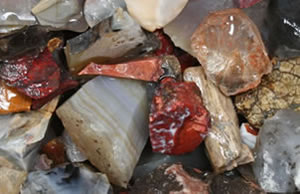
Rough rock crushed to size and ready for the rock tumbler.
What Happens in a Rock Tumbler?
In this video we replace the lid of a Thumler's MP-1 rotary tumbler with a piece of glass to show what happens in the barrel with various amounts of rock.
The amount of rock placed into a rock tumbler barrel is very important. Too much rock does not allow enough space for tumbling to occur. Too little rock results in ineffective tumbling.
The ideal barrel level is about 2/3 full.
Barrel 2/3 Full - Great Tumbling Action
This is the right amount of rock. Notice how the rocks are lifted up the right side of the barrel and then tumble downslope to the left. There is plenty of space above the rocks to allow a tumbling action.
Barrel Too Full - No Tumbling Action
If you fill the barrel more than 2/3 to 3/4 full, there is not enough space in the barrel to allow a tumbling action. In the video you can see there is very little tumbling. The rocks stay in the same place as the barrel turns.
If you fill the barrel too full and tumble for seven days, you will open the barrel and find that your rocks have not changed very much and your grit has not broken down. Filling the barrel too full will also put stress on the tumbler motor, tumbler belt and tumbler bearings, reducing their useful life.
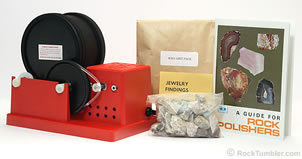
The tumbler used in the video above is the Model MP-1 by Thumler's Tumblers. It is sold as a kit with everything that you need to tumble one batch of rocks and make two jewelry projects with your tumble-polished gemstones.
Barrel Not Full Enough - Damaged Rocks
If you run the rock tumbler with less than about 1/2 barrel of rock, the rocks will be violently tossed around in the barrel. This can result in broken, bruised, or chipped stones. Also, the jerky motion will be hard on your tumbler's bearings, belt, and motor. And notice how much noise the tumbler is making. If you hear rocks crashing in the barrel, you know that you don't have enough rocks in there.
What some people do: Some people add large ceramic media to the barrel to bring it up to recommended operating level. Sometimes this works great. However, if you are tumbling soft rocks (less than 5 on the Mohs scale), rocks that have a directional hardness, or rocks that do not have a uniform hardness, they might not shape nicely. It is best to wait until you have enough rocks or use a smaller tumbler.
Happy Tumbling!

RockTumbler.com Authors
 |
Hobart M. King has decades of rock tumbling experience and writes most of the articles on RockTumbler.com. He has a PhD in geology and is a GIA graduate gemologist. He also writes the articles about rocks, minerals and gems on Geology.com. |